Gym rubber flooring resists fire better than carpet but isn't fireproof—meets commercial standards nationwide.
Is Gym Rubber Flooring Fire-Resistant?
Most gym rubber flooring in India has moderate fire resistance but is not completely fireproof — it resists ignition better than carpet or wood but will burn when exposed to sustained high temperatures or direct flames.
I've been supplying rubber flooring across Mumbai, Delhi, and Hyderabad since 2016, and fire safety questions come up regularly, especially from gym owners setting up in commercial buildings where fire NOCs matter.
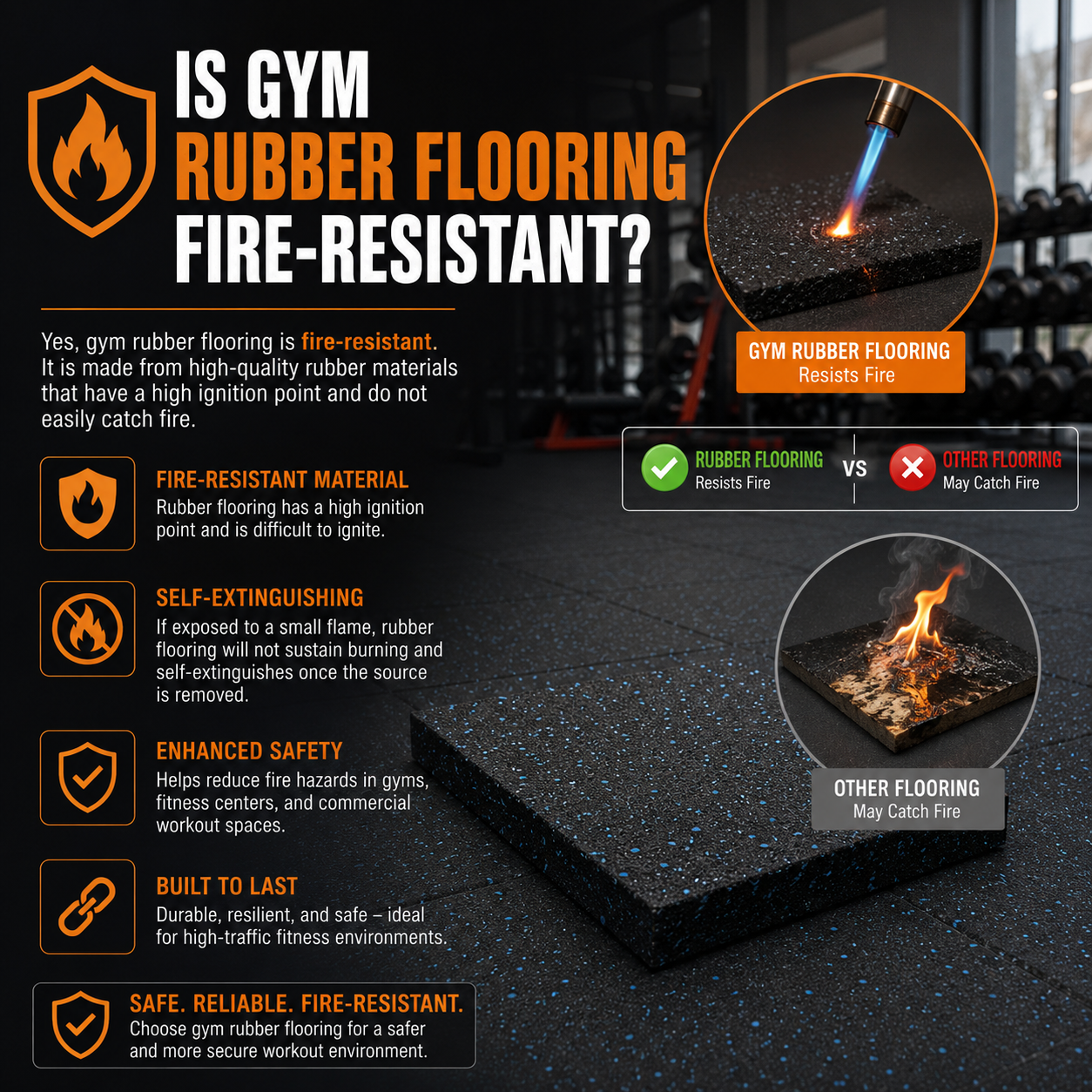
The reality is this: rubber flooring won't fuel a fire the way synthetic carpets do, but it's also not the same as fire-rated ceramic tiles. Understanding what "fire-resistant" actually means for your gym will help you make the right choice.
What Fire-Resistant Actually Means for Rubber Flooring
Fire resistance isn't binary. Materials fall on a spectrum from highly flammable to fire-retardant to fireproof.
Gym rubber flooring typically sits in the fire-retardant category. This means it resists catching fire easily and doesn't spread flames quickly, but it will eventually burn if exposed to enough heat.
The rubber we supply is made from recycled tyre rubber or virgin rubber compounds. Recycled rubber naturally has better fire resistance because it's already been vulcanized once — it takes significant heat to ignite it.
In practical terms: dropping a cigarette on rubber flooring won't cause a fire. The material will char slightly but won't catch flame. Compare this to foam mats or vinyl, which can melt and burn much faster.
Most quality rubber flooring scores a Class 2 or Class 1 fire rating under Indian standards (IS 9968). This makes it acceptable for commercial gyms in most municipal jurisdictions across Mumbai, Pune, and Bangalore.
Fire Rating Standards You Should Know
When applying for your gym's fire NOC, the fire department will check your flooring's certification.
In India, we follow the IS 9968 standard for flame spread. Here's what the classes mean:
Class 1: Highest fire performance. Flame spread index below 25. This is what airports and hospitals need.
Class 2: Moderate fire performance. Flame spread index 26-75. Most commercial rubber flooring falls here. Perfectly acceptable for gyms.
Class 3: Lower fire performance. Flame spread 76-200. Budget flooring often lands here.
Our rubber tiles and rolls typically meet Class 2 standards. For projects where Class 1 is mandatory — say, a gym inside a mall in Lower Parel or a corporate building in Gurgaon — we can source specialized fire-rated rubber, though it costs 20-30% more.
Always ask your supplier for test certificates. We provide these with bulk orders, especially when gym owners need them for municipal approvals.
Thickness and Fire Performance
Here's something most suppliers won't tell you: thicker rubber doesn't necessarily mean better fire resistance.
Fire resistance depends on the rubber compound and any fire-retardant additives mixed in during manufacturing. A 10mm tile with proper additives can outperform a 40mm tile made from lower-grade material.
That said, thicker flooring does provide more thermal mass, which slows heat transfer to the subfloor. This matters in a fire scenario where you want to delay structural damage.
For functional training zones where you're dropping weights, I recommend our 15mm rubber tiles at Rs.85 per sq ft or 20mm tiles at Rs.100 per sq ft. Both offer good fire performance plus the impact resistance you need.
For cardio areas, our 6mm rubber rolls at Rs.95 per sq ft work well. Thinner profile, easier installation, and still fire-retardant enough for any commercial gym.
Smoke Production: The Real Danger
In actual fire emergencies, smoke kills more people than flames do.
Rubber flooring does produce smoke when it burns. The smoke from recycled rubber is thick and dark, with a strong odor. It's not as toxic as PVC smoke, but it's still dangerous in enclosed spaces.
This is why proper ventilation matters in your gym design. Those exhaust fans aren't just for keeping the gym cool — they're part of your fire safety strategy.
If you're setting up a basement gym in Mumbai or Noida, pay extra attention to smoke evacuation routes. The fire department will check this during inspections.
Some premium rubber flooring includes low-smoke additives. These reduce smoke density by 30-40%. If your gym is in a high-rise or enclosed space, ask about low-smoke options. We can source these from our Bhiwandi warehouse, though lead time is usually 2-3 weeks.
Practical Fire Safety Beyond Flooring
Fire-resistant flooring is just one piece of your gym's fire safety puzzle.
I've visited hundreds of gyms across Andheri, Whitefield, and Banjara Hills. The ones that pass fire inspections smoothly do these things right:
Clear exit paths: Don't block fire exits with equipment. That leg press can't sit in front of the emergency door, no matter how well it fits there spatially.
Fire extinguishers: Mount ABC-type extinguishers every 15 meters. They handle electrical fires, which are common in gyms with treadmills and AC units.
Electrical safety: Most gym fires start from electrical faults, not flooring. Get a licensed electrician to check your load capacity, especially if you're running 8+ treadmills.
No open flames: Sounds obvious, but I've seen gyms use candles for ambiance or diyas during Diwali. Not worth the risk on rubber flooring.
Regular inspections: Check for cigarette butts near entrances (if your building allows smoking outside), frayed wires under equipment, and overheating transformers.
Your rubber flooring will do its job of not fueling a fire. But prevention beats resistance every time.
Cost Considerations for Fire-Rated Flooring
Standard commercial rubber flooring starts at Rs.50 per sq ft for our 2mm rolls. This meets basic fire safety for most gyms.
For a 2000 sq ft gym in Powai or Koramangala, you're looking at:
• Budget option: 10mm rubber tiles at Rs.55 per sq ft = Rs.1,10,000
• Mid-range: 15mm rubber tiles at Rs.85 per sq ft = Rs.1,70,000
• Premium: 20mm rubber tiles at Rs.100 per sq ft = Rs.2,00,000
All three options have similar fire resistance. The price difference is about durability and impact absorption, not fire performance.
If you specifically need certified Class 1 fire-rated rubber for a mall or airport gym, budget an extra 25% over these prices. We source this on demand from our Delhi NCR warehouse.
Installation adds Rs.15-20 per sq ft for tiles, Rs.10-15 per sq ft for rolls.
Fire-rated certificates cost Rs.3,000-5,000 if you need official documentation for your fire NOC application. We include these free with orders above 1,500 sq ft.
Getting Your Fire NOC With Rubber Flooring
Most gym owners worry unnecessarily about fire clearance. Rubber flooring rarely causes issues if you have the right paperwork.
Here's what the fire department typically wants to see:
1. Material test certificate showing fire rating
2. Manufacturer's fire performance data
3. Installation invoice (proves you used commercial-grade material)
4. Overall gym layout with exit paths marked
We provide the first two documents with every order. Keep them in your license file.
The inspection itself focuses more on exits, extinguishers, and electrical safety than on flooring. I've never seen a gym rejected solely because of rubber flooring — only when the owner had no documentation at all.
Processing time for fire NOCs varies wildly. In Mumbai, expect 3-4 weeks. In Hyderabad, sometimes just 10 days. Start this process before your equipment arrives, not after.
Need help with fire-rated rubber flooring for your gym? We've handled fire NOC requirements for gyms across every major Indian city.
WhatsApp us at +91-9818241705 — free quote within 4 hours.