Gym flooring needs 10-40mm tiles or 2-10mm rolls depending on equipment weight and drop height.
How Thick Should Gym Rubber Flooring Be?
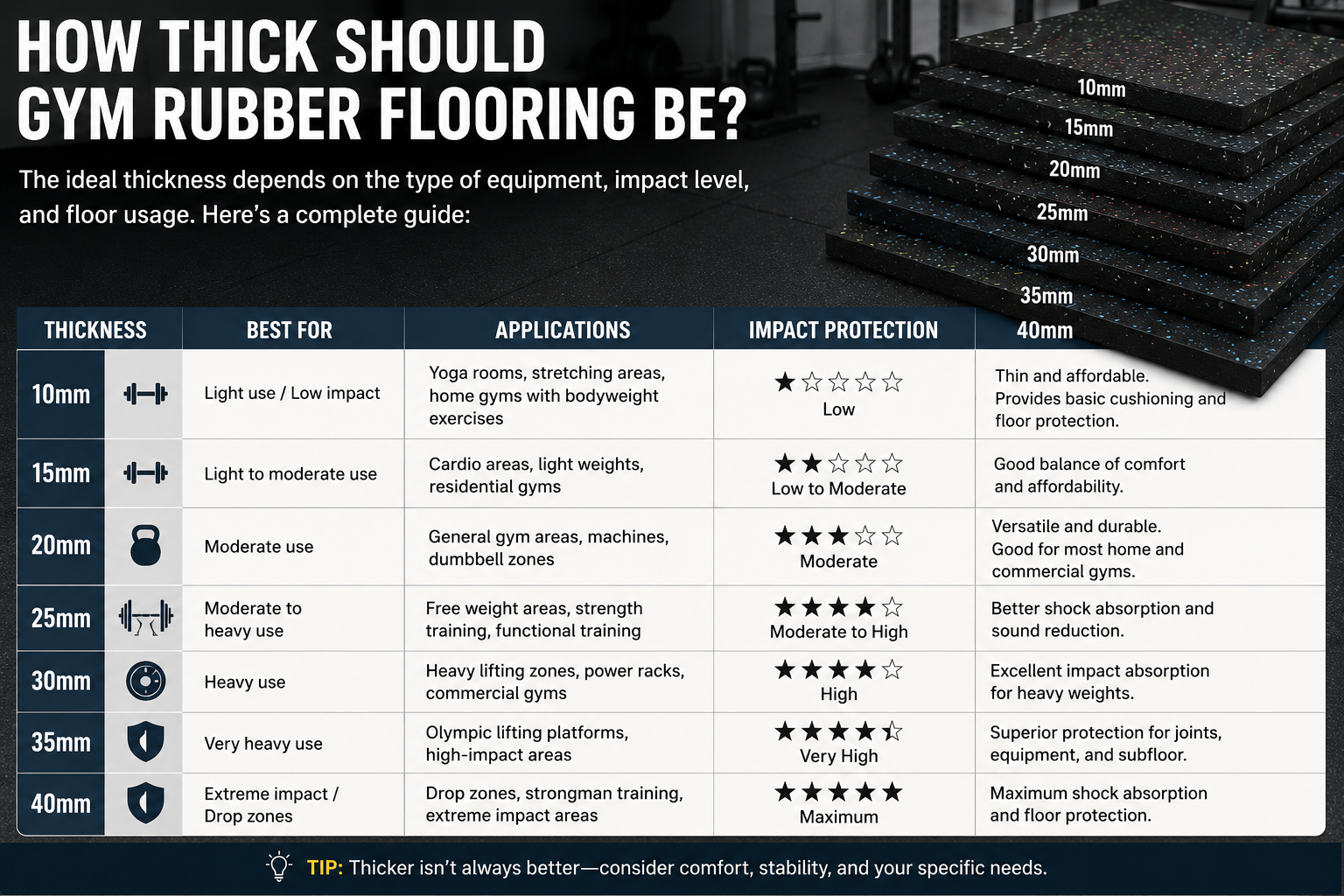
Gym rubber flooring thickness should range from 10mm to 40mm for tiles and 2mm to 10mm for rolls, depending on your equipment weight, drop height, and workout type.
I've installed flooring in over 300 gyms across Mumbai, Pune, and Bangalore since 2016. The thickness question comes up every single time, and here's what actually matters.
Most gym owners either go too thin to save money or too thick because they assume thicker is always better. Both approaches waste money.
Let me break down exactly what thickness you need based on what's happening in your gym.
Thickness Based on Gym Type and Equipment
A CrossFit box in Andheri needs different flooring than a yoga studio in Koramangala. The equipment and movement patterns determine everything.
Functional training and CrossFit gyms: 15mm to 20mm rubber tiles work best. You're dealing with barbell drops, box jumps, and sled pushes. I recommend 15mm tiles at Rs.85 per sq ft for most functional training spaces. If you're regularly dropping loaded barbells from overhead, go with 20mm at Rs.100 per sq ft.
Traditional weight training gyms: 10mm to 15mm handles it perfectly. Dumbbells get dropped, barbells get racked hard, but you're not doing Olympic lifts from overhead. A 2000 sq ft gym in Thane recently used our 10mm tiles at Rs.55 per sq ft and saved almost Rs.60,000 compared to 15mm.
Cardio zones and group fitness: 6mm to 10mm rubber rolls work well here. Treadmills, ellipticals, and spin bikes don't need thick flooring. I typically spec 6mm rolls at Rs.95 per sq ft for these areas. They're easier to install around equipment too.
Yoga and Pilates studios: 4mm to 6mm rolls are ideal. Anything thicker feels unstable for balance work. A studio in Bandra went with 4mm rolls at Rs.80 per sq ft across 1200 sq ft and spent just Rs.96,000.
Powerlifting and Olympic lifting platforms: 20mm to 30mm minimum. Heavy deadlifts and clean-and-jerks from serious lifters need serious protection. The powerlifting gym near Malad uses 30mm tiles at Rs.150 per sq ft in their main lifting area.
What Happens If You Go Too Thin
I visited a gym in Vashi last month where the owner installed 6mm rubber rolls throughout to save money. His functional training area looked fine for about three months.
Then the subfloor started cracking underneath. Barbell drops punched through. He spent Rs.1.2 lakhs initially but ended up spending another Rs.1.8 lakhs to rip it out and install 15mm tiles properly.
Thin flooring under heavy equipment causes:
Subfloor damage that costs more to repair than proper flooring would have cost initially. Noise complaints from neighbors or floors below, especially in Mumbai high-rises. Equipment instability, particularly squat racks and cable machines. Faster wear patterns, meaning replacement in 2-3 years instead of 8-10 years.
If your budget is tight, it's smarter to use proper thickness in high-impact zones and thinner flooring in low-impact areas rather than going thin everywhere.
What Happens If You Go Too Thick
A gym owner in Navi Mumbai installed 40mm tiles throughout his entire 3000 sq ft space. He spent Rs.6.3 lakhs when Rs.3.3 lakhs would have done the job perfectly.
That's Rs.3 lakhs wasted. No performance benefit. No durability benefit.
Beyond wasted money, excessive thickness creates problems:
Door clearance issues, especially in older Mumbai buildings with standard door frames. Tripping hazards at transitions between floored and non-floored areas. Unnecessary height that affects rack positions and ceiling clearance for pull-ups. Unstable feeling for certain exercises, particularly single-leg work and agility drills.
The 40mm tiles at Rs.210 per sq ft exist for very specific applications like outdoor dropping zones or specialized athletic facilities. Not for your standard commercial gym.
The Right Thickness for Multi-Purpose Gym Spaces
Most gyms in India aren't single-purpose. You've got a free weight area, some cardio equipment, maybe a functional training zone, and a space for group classes.
Here's my standard recommendation for a typical 2000-2500 sq ft gym:
Free weight zone (30-40% of space): 15mm tiles at Rs.85 per sq ft. This handles dumbbell drops up to 40kg and barbell work safely.
Functional training area (20-30% of space): 20mm tiles at Rs.100 per sq ft if you're doing barbell work. If it's mostly kettlebells and bodyweight, 15mm works fine.
Cardio zone (20-30% of space): 6mm rolls at Rs.95 per sq ft. Easy to install, comfortable underfoot, protects the floor from equipment weight.
Group fitness area (10-20% of space): 6mm to 8mm rolls depending on the activities. If you're doing heavy MetCons with equipment drops, go 8mm at Rs.110 per sq ft.
This zoned approach typically saves 20-30% compared to using one thickness throughout while actually giving you better performance in each area.
Special Considerations for Indian Gym Environments
Installing flooring in Mumbai is different from what you'd do in Dubai or New York. Our climate and building types matter.
High-rise gyms: If you're above the ground floor, go one thickness level up in your drop zones. A sixth-floor gym in Powai uses 20mm in areas where I'd normally spec 15mm. Sound transmission matters more than ground-level spaces.
Monsoon moisture: Thicker flooring provides more protection for your subfloor during monsoon season. That 2mm difference between 8mm and 10mm rolls can prevent moisture-related subfloor damage in poorly ventilated spaces.
Temperature fluctuations: Rubber expands and contracts. In non-air-conditioned spaces, leave proper expansion gaps. This matters more with tiles than rolls, but thickness affects how much movement you'll see.
Basement gyms: Common in Delhi NCR. Usually need 15mm minimum even for light work because basement concrete can be lower quality and more prone to cracking.
How to Calculate Costs Based on Thickness Choices
Let's run real numbers for a 2000 sq ft gym:
All 10mm tiles: 2000 × Rs.55 = Rs.1,10,000
All 15mm tiles: 2000 × Rs.85 = Rs.1,70,000
All 20mm tiles: 2000 × Rs.100 = Rs.2,00,000
Smart zoned approach:
800 sq ft at 15mm (Rs.85) = Rs.68,000
600 sq ft at 10mm (Rs.55) = Rs.33,000
600 sq ft at 6mm rolls (Rs.95) = Rs.57,000
Total = Rs.1,58,000
The zoned approach saves you Rs.12,000 compared to all 15mm, and it performs better because each area has appropriate thickness.
We stock everything from our Bhiwandi warehouse outside Mumbai, with additional inventory in Delhi NCR and Hyderabad. Installation typically takes 2-3 days for a standard gym size.
The starting price across our range is Rs.50 per sq ft for 2mm rolls, going up to Rs.210 per sq ft for 40mm tiles, but most gyms end up in the Rs.85-100 per sq ft range for their main training areas.
I'm happy to walk you through exactly what thickness makes sense for your specific gym layout, equipment mix, and budget. WhatsApp us at +91-9818241705 — free quote within 4 hours.