Quality rubber gym tiles last eight to twelve years, with premium options exceeding fifteen years' lifespan.
How Long Do Gym Tiles Last?
Quality rubber gym tiles last 8 to 12 years with proper maintenance, while premium options can exceed 15 years in commercial gym settings.
I've been supplying rubber flooring across Mumbai, Delhi, and Hyderabad since 2016. The lifespan question comes up in almost every conversation with gym owners, and the answer depends on multiple factors that I'll break down for you.
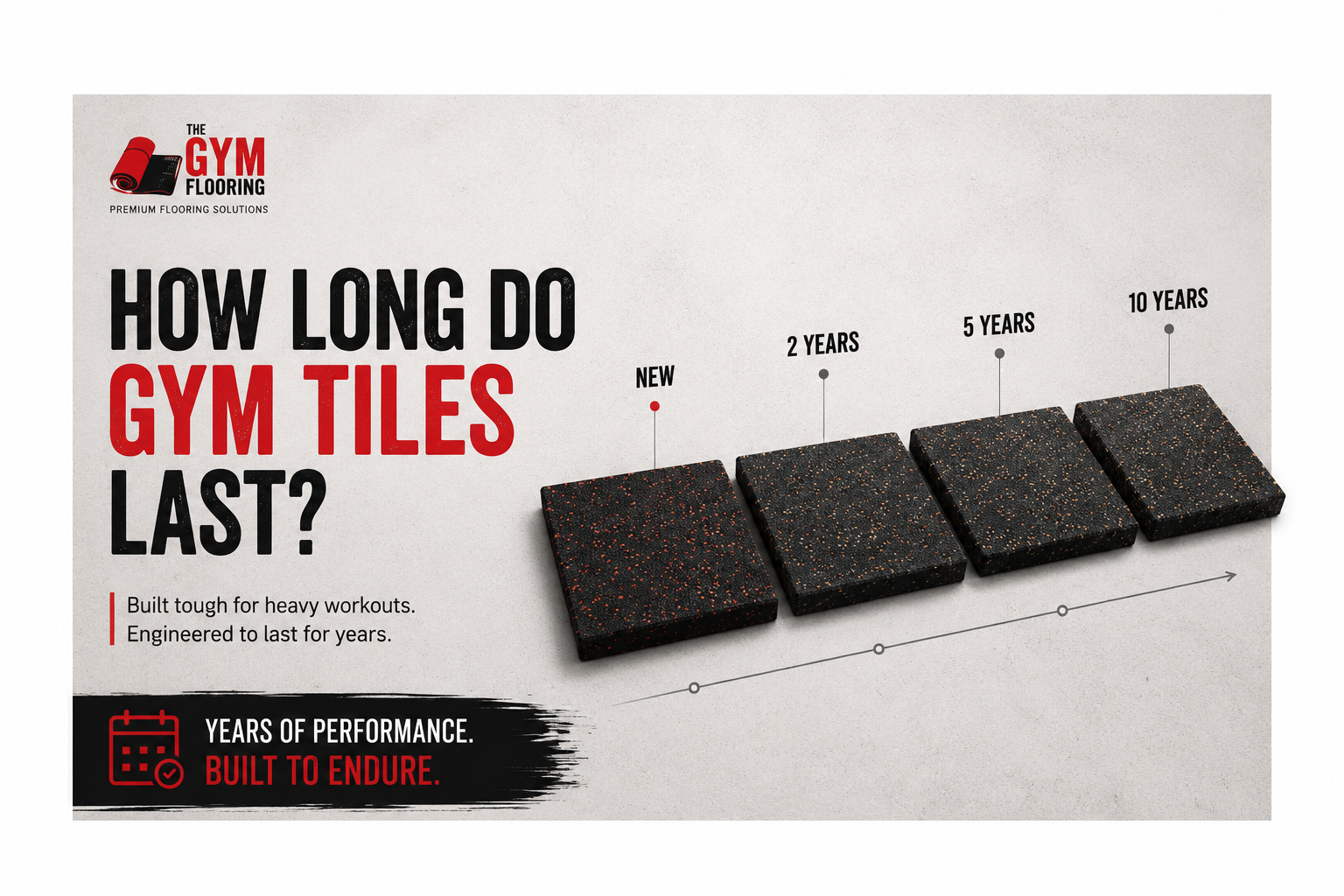
Let me be clear: not all gym tiles are created equal. The difference between a tile that lasts 5 years versus one that lasts 12+ years often comes down to material quality, thickness, and how the gym uses the space.
Material Quality Determines Everything
Virgin rubber tiles outlast recycled rubber significantly. We're talking 10-15 years versus 5-8 years.
Virgin rubber maintains its density and shock absorption properties far longer. A 20mm virgin rubber tile at Rs.100 per sq ft might seem expensive initially, but it's actually cheaper than replacing a lower-quality tile twice in the same period.
Recycled rubber works fine for home gyms or light commercial use. But for a busy commercial gym in Andheri or Lajpat Nagar pulling 100+ members daily, virgin rubber is the only sensible choice.
The surface texture matters too. Tiles with a hammer-top or coin-pattern surface resist wear better than smooth surfaces. They hide scuff marks and maintain their grip even after years of heavy foot traffic.
Thickness Affects Longevity More Than You Think
Thicker tiles last longer because there's simply more material to wear through.
Our 10mm tiles at Rs.55 per sq ft work well for yoga studios or cardio zones. They'll give you 6-8 years of solid service with normal use.
For free weight areas, I always recommend minimum 15mm (Rs.85 per sq ft) or ideally 20mm (Rs.100 per sq ft). These handle dropped weights without compressing permanently. You're looking at 10-12 years easily.
Heavy lifting zones need 30mm or 40mm tiles. Yes, the 40mm option costs Rs.210 per sq ft, but powerlifting gyms in Mumbai like those in Powai and BKC prefer these because they last 12-15 years even under extreme abuse. That's Olympic barbells dropping from overhead, daily.
Thinner tiles compress faster, develop permanent indentations, and lose their shock-absorbing properties sooner. The upfront savings rarely justify the shorter lifespan.
Usage Intensity Changes the Timeline
A home gym with 1-2 users daily will see tiles last 15+ years. I've seen personal gyms in Bangalore still using the same 15mm tiles after 12 years with minimal wear.
Commercial gyms are different. A budget gym with 50-80 members might get 8-10 years from quality tiles. Premium gyms with 150+ daily visits need to think in terms of 6-8 years for high-traffic zones.
CrossFit boxes and functional training spaces are the most demanding. Constant barbell drops, sled pushes, and battle rope slams accelerate wear. Even our thickest tiles show significant wear after 7-8 years in these environments.
The good news? Tiles are modular. You don't replace the entire floor. Just swap out the worn sections in your heavy lifting zone while keeping the rest. This is why tiles make more financial sense than rolls for commercial spaces.
Maintenance Practices That Extend Lifespan
Cleaning might seem basic, but it matters. Gym owners who mop regularly with mild detergent see their floors last 2-3 years longer than those who don't.
Dirt and grit act like sandpaper. Members walk it in from the street, and every footstep grinds it against the rubber surface. A quick daily sweep and weekly mop prevents this abrasive wear.
Avoid harsh chemicals. I've seen gym owners in Pune destroy perfectly good flooring with strong acid cleaners, thinking they're doing deep cleaning. The rubber breaks down, becomes brittle, and cracks. Stick to pH-neutral cleaners.
Direct sunlight degrades rubber over time. If your gym has large windows, UV film or curtains help. Outdoor installations need UV-resistant rubber, which costs more but handles sun exposure without deteriorating.
Temperature extremes affect lifespan too. Mumbai gyms don't face this much, but gyms in extreme climates need climate control. Rubber expands and contracts with temperature changes. Constant cycling weakens the material structure.
When to Replace Rather Than Repair
Surface wear is normal. Minor scuffs, slight color fading, and light texture smoothing don't require replacement. The tiles still function perfectly.
Replace tiles when you see permanent compression that doesn't bounce back. Press your thumb firmly into the tile. If the indentation remains after 10 seconds, the rubber has lost its elasticity.
Cracking or tearing means immediate replacement. This happens with age, but also with poor-quality tiles. I've seen cheap tiles crack within 3 years in Mumbai's humidity.
Edge curling indicates the tile has reached end-of-life. This creates trip hazards and means the rubber compound has degraded beyond recovery.
Smell changes matter. Fresh rubber has a mild odor that fades within weeks. If old tiles start smelling strongly or differently, bacterial growth has penetrated the material. Time for replacement.
Real Cost of Ownership Over Time
Let's compare actual numbers for a 2000 sq ft commercial gym in Mumbai.
Option one: Budget tiles at Rs.40 per sq ft (not ours) = Rs.80,000. Replace after 5 years. Total cost over 15 years = Rs.2,40,000.
Option two: Our 20mm quality tiles at Rs.100 per sq ft = Rs.2,00,000. Replace after 12 years. Total cost over 15 years = Rs.2,00,000 plus Rs.33,000 partial replacement = Rs.2,33,000.
The difference seems minimal, but factor in installation costs (roughly Rs.15-20 per sq ft each time), downtime during replacement, and member inconvenience. The quality option wins clearly.
For home gyms, the math is even simpler. Spend Rs.85-100 per sq ft once and forget about it for 15 years. The peace of mind alone justifies the investment.
I've supplied flooring to over 300 gyms across India. The ones that chose quality over price are still using their original floors. The ones that went cheap have become repeat customers, not by choice but by necessity.
Our warehouses in Bhiwandi, Delhi NCR, and Hyderabad keep full stock of all thicknesses. We deliver across India, and most Mumbai orders reach within 48 hours.
WhatsApp us at +91-9818241705 — free quote within 4 hours.