Neither is universally better; tiles suit smaller, DIY, heavy-lift spaces while rolls fit larger commercial gyms.
Are Interlocking Gym Mats Better Than Rolled Mats?
Interlocking tiles and rolled mats each serve different gym setups, and neither is universally better. The right choice depends on your space type, workout intensity, equipment weight, and whether you need permanent or temporary flooring.
I've been supplying gym flooring across Mumbai, Pune, and Delhi since 2016. Most gym owners assume tiles are always superior because they're modular. But I've seen rolled rubber outperform tiles in specific scenarios, especially in larger commercial gyms and CrossFit boxes.
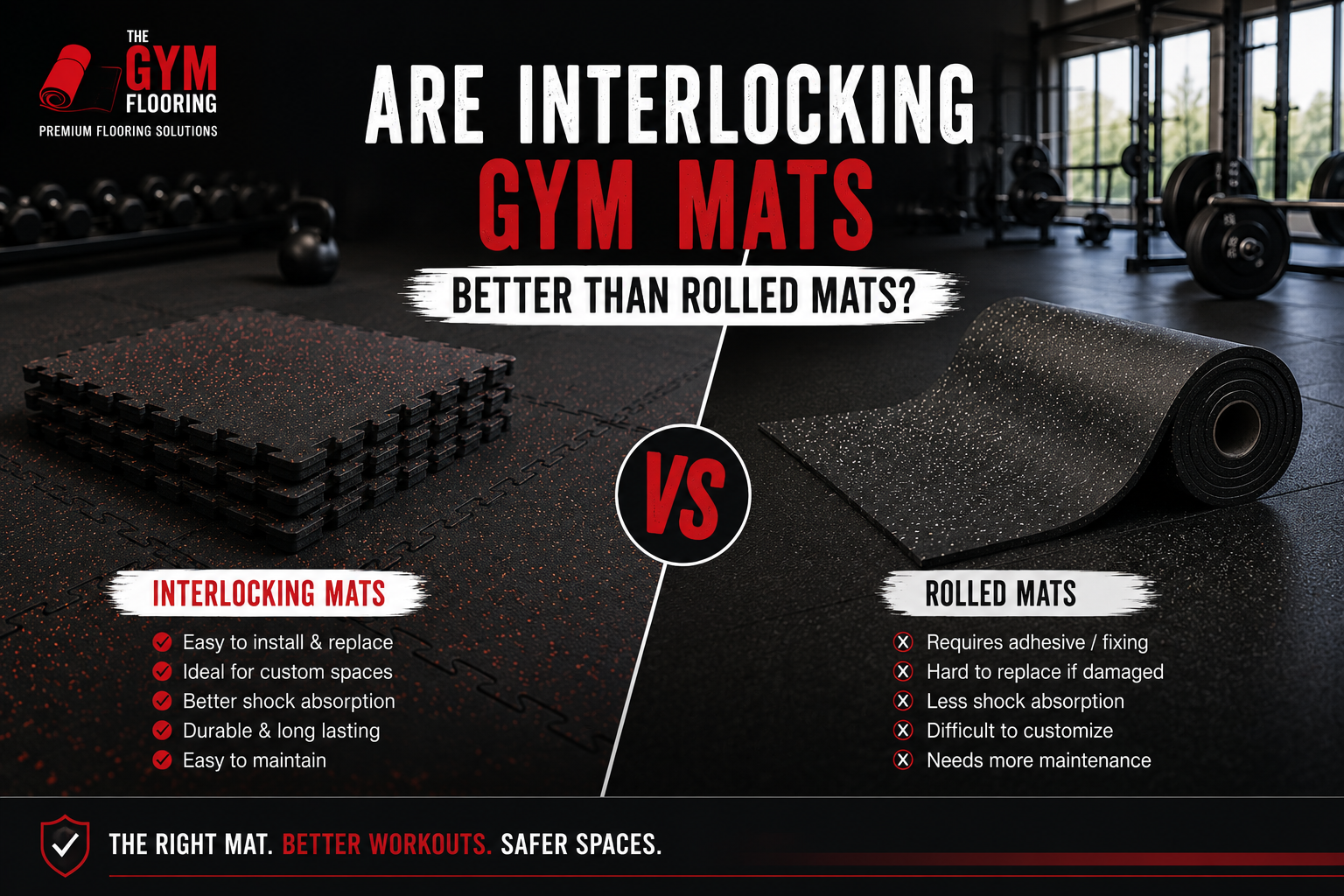
Let me break down exactly when each option makes sense for your gym.
Installation Speed and Flexibility
Interlocking rubber tiles win if you need DIY installation or plan to reconfigure your space frequently.
Our 10mm tiles at Rs.55 per sq ft lock together without adhesive. A 1000 sq ft gym in Andheri took three people just four hours to install. You can lift sections anytime to access subfloor plumbing or electrical work. Home gym owners in Mumbai apartments prefer tiles because they're tenant-friendly and removable.
Rubber rolls require more planning. Our 4mm rolls at Rs.80 per sq ft need careful measurements and adhesive for permanent installation. A 2000 sq ft gym in Gurgaon took a full day with professional installers. The seams must align perfectly, or you'll see visible lines where rolls meet.
But here's what most suppliers won't tell you: rolls create fewer seams overall. A large gym using tiles has hundreds of interlocking joints. Rolls might have just 3-4 seams across the entire floor. Fewer seams mean fewer weak points where chalk dust and sweat accumulate.
For permanent commercial setups above 1500 sq ft, I typically recommend rolls. For home gyms, rental spaces, or areas under 800 sq ft, tiles make more sense.
Durability Under Heavy Equipment
Thickness matters more than format when it comes to equipment protection.
Our 20mm interlocking tiles at Rs.100 per sq ft handle deadlift platforms and squat racks perfectly. A powerlifting gym in Bangalore uses these under competition-grade equipment with zero cracking after two years. The 30mm tiles at Rs.150 per sq ft are what serious strength gyms in Delhi choose for Olympic lifting zones.
Rolled rubber works equally well for heavy loads, but your thickness options are limited. Rolls max out at 10mm (Rs.135 per sq ft). This works fine for treadmills, ellipticals, and moderate free weight areas. But if you're dropping 150kg barbells regularly, 10mm rolls won't cut it.
I've replaced worn-out 6mm rolls in a CrossFit gym in Pune after just 18 months of heavy use. We upgraded them to 40mm interlocking tiles at Rs.210 per sq ft in the lifting zones. The cardio area kept 8mm rolls at Rs.110 per sq ft, which was perfectly adequate.
The general rule: if equipment stays stationary or movements are controlled, rolls work beautifully. If you're dropping weights, doing sled pushes, or running high-intensity classes, thicker tiles provide better impact absorption and longevity.
Budget Considerations for Different Gym Sizes
Your total cost isn't just material price per sq ft. Installation labor, wastage, and replacement cycles all factor in.
For a 500 sq ft home gym, 15mm tiles at Rs.85 per sq ft cost Rs.42,500 in materials. You install them yourself in an afternoon. Zero labor cost. Wastage is minimal because you can cut tiles to fit corners and edges.
The same space in 6mm rolls at Rs.95 per sq ft costs Rs.47,500, plus Rs.8,000-12,000 for professional installation and adhesive. Total outlay is higher despite similar per-sq-ft pricing.
But flip the scenario to a 3000 sq ft commercial gym. Tiles create more seams, take longer to install even without adhesive, and require perfect subfloor leveling across hundreds of individual pieces. Rolls go down faster, create a seamless appearance, and actually reduce total project time by 30-40%.
A gym chain in Hyderabad saved Rs.85,000 on a 4000 sq ft facility by choosing 8mm rolls over 10mm tiles. Installation was faster, they needed less edge trimming, and the seamless look matched their premium branding better.
For multi-location gym owners, rolls often make financial sense despite higher per-unit costs. For single-location or home gyms, tiles offer better value and flexibility.
Maintenance and Long-Term Performance
Daily cleaning differs significantly between the two formats.
Interlocking tiles have grooves and seams where dust, chalk, and moisture settle. A gym in Powai reported spending 20 extra minutes daily cleaning between tile joints. During monsoon season in Mumbai, those seams can trap humidity if your gym isn't well-ventilated.
Our tiles are easy to replace individually if one section gets damaged. A gym in Thane had a 2x2 ft area damaged by a dropped plate tree. They ordered just four tiles as replacements rather than redoing the whole floor. That's a major advantage for high-traffic zones.
Rolled rubber creates nearly seamless surfaces that mop clean quickly. The same Powai gym switched their cardio section to 4mm rolls and cut cleaning time by half. But if rolled rubber gets damaged, you're often replacing entire sections, not just one tile.
I've noticed tiles shift slightly over time in spaces without wall-to-wall coverage. A Pilates studio in South Mumbai had 1-2mm gaps appear between tiles after a year. We added edge borders, which solved the movement issue completely.
Rolls stay put once adhered but can show seam separation if the subfloor wasn't perfectly clean during installation. A gym in Noida had seam lifting after six months because the installer didn't prime the concrete properly.
Best Applications for Each Type
Here's how I guide gym owners based on actual usage patterns:
Choose interlocking tiles when you have:
Home gyms or garage setups where DIY installation matters
Rental properties where flooring must be removable
Heavy lifting zones needing 20mm, 30mm, or 40mm thickness
Smaller spaces under 1000 sq ft
Budget constraints that eliminate professional installation costs
Plans to reconfigure gym layout frequently
Choose rolled rubber when you have:
Commercial gyms above 1500 sq ft
Permanent installations where seamless appearance matters
Cardio and functional training zones with moderate impact
Professional installation already budgeted
High-moisture environments where minimal seams prevent water intrusion
Corporate gyms or premium facilities prioritizing aesthetics
I often recommend hybrid approaches. A 2500 sq ft gym in Lower Parel uses 8mm rolls throughout the main floor (Rs.110 per sq ft) and 30mm interlocking tiles (Rs.150 per sq ft) in the 400 sq ft deadlift platform area. This balanced cost, performance, and practicality perfectly.
Another gym in Vashi created a modular CrossFit space using 20mm tiles for their lifting zones and metabolic conditioning area, but used 6mm rolls under fixed rig installations. They can rearrange the open floor as needed while keeping the rig area permanently protected.
Your subfloor condition also influences the decision. Tiles are more forgiving on slightly uneven concrete. Rolls highlight every imperfection unless you level the subfloor first, which adds cost.
We stock both formats in our Bhiwandi warehouse outside Mumbai, plus locations in Delhi NCR and Hyderabad. Most orders ship within 24-48 hours across Maharashtra, Karnataka, and North India.
The real answer isn't which type is better overall. It's which type solves your specific challenges. A 300 sq ft apartment gym has completely different needs than a 5000 sq ft franchise location.
Send me your gym dimensions, equipment list, and whether this is permanent or temporary. I'll recommend the exact product, thickness, and format that makes sense for your usage and budget.
WhatsApp us at +91-9818241705 — free quote within 4 hours.